
The Real Cost of Fitness in Singapore: Why Sustainable Fitness Is Harder Than It Looks
Behind every gym membership, personal-training session and fitness programme is an economic system of rent, equipment, people, professional standards, technology, customer acquisition, continuing education and risk. Understanding that system helps explain why the future of fitness will be about much more than access to exercise equipment.
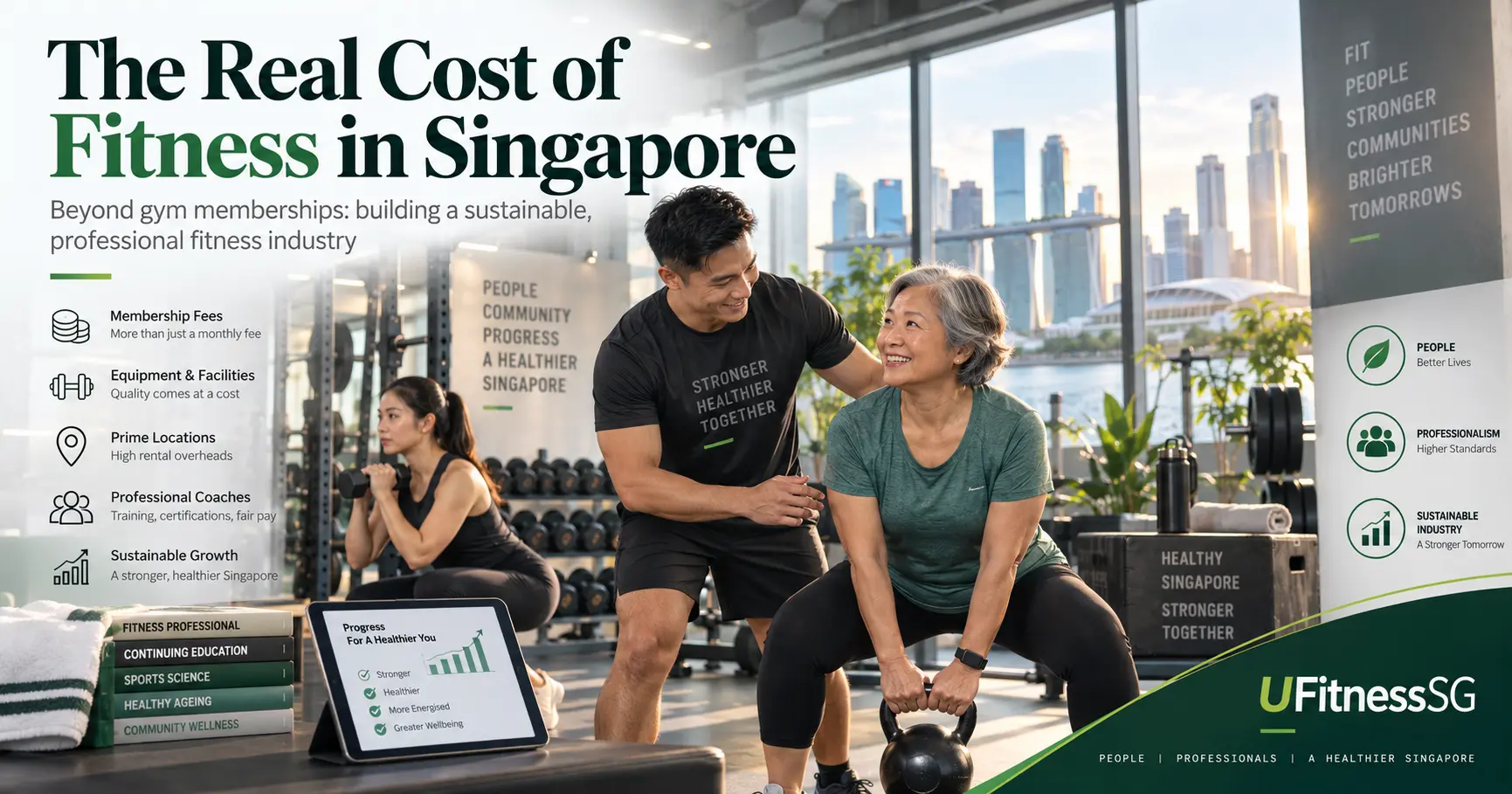
Health and fitness have been part of my life for decades. I have experienced this industry from different perspectives – as an athlete, trainer, fitness manager and, increasingly, through the lens of active ageing, preventive health and community fitness.
That experience has taught me something that is easy to miss from outside the industry: fitness can look simple to consume, but it is difficult to deliver sustainably.
A consumer sees a membership fee, a personal-training rate or a class price. An operator sees rent, fit-out costs, equipment, depreciation, maintenance, utilities, payroll, instructor fees, software, insurance, cleaning, sales, marketing, financing, customer acquisition and the constant challenge of retaining members.
A responsible exercise professional sees another layer: professional qualifications, continuing education, CPR and AED competency, insurance, assessment, programme design, documentation, scope of practice and the responsibility to remain current as exercise science evolves.
How do we make fitness accessible to consumers while keeping the businesses and professionals delivering it safe, competent and economically sustainable?
A 2026 event that makes the economics impossible to ignore
In September 2026, the closure of True Fitness and True Yoga in Singapore brought the economics of the fitness industry sharply into public view.
Channel NewsAsia reported on 11 September 2026 that True Fitness and True Yoga in Singapore were set to close after their directors resolved that the companies could no longer continue operating because of their liabilities. Provisional liquidators were appointed, and creditors’ voluntary winding-up was proposed subsequently. [1]
This article does not attempt to judge one operator’s decisions. The case is useful because it illustrates several structural pressures faced by capital-intensive fitness businesses.
CNA also reported that the parent company pointed to increasingly intense competition, higher costs of attracting customers, boutique gyms, gyms within condominiums and residential developments, and alternatives such as online training, mobile apps, video platforms and virtual coaching. It also cited high operating costs and tight cash flow. [1]
This is important because it moves the discussion beyond the simplistic idea that a fitness business succeeds merely by signing up more members.
A business can generate substantial revenue and still struggle if its cost structure, financing, liabilities, customer-acquisition costs and cash-flow requirements cannot be supported by that revenue.
Why a full-scale gym is a capital-intensive business
Traditional commercial fitness is a form of high operating-leverage business. Many major costs exist whether a facility serves 100 members or 1,000 members.
Before the doors even open, an operator may have committed substantial capital to lease deposits, renovation, flooring, changing facilities, showers, electrical works, air-conditioning, access systems, lockers, cardio equipment, resistance machines, free weights and technology.
After opening, those assets do not eliminate costs. They create ongoing ones.
| Cost layer | What sits behind it | Why it matters |
|---|---|---|
| Property & occupancy | Rent, service charges, deposits, renovation and reinstatement obligations. | Much of this cost is fixed. It continues even when utilisation is weak. |
| Equipment & fit-out | Cardio machines, racks, weights, flooring, studios, lockers, showers and specialist equipment. | Significant upfront capital expenditure is followed by depreciation, maintenance and replacement. |
| Utilities & maintenance | Air-conditioning, lighting, water, cleaning, servicing, repairs and equipment downtime. | Large facilities consume resources whenever they are operating, not only when every machine is occupied. |
| People | Operations teams, instructors, trainers, sales, customer service, management and cleaning staff. | Fitness is ultimately a service business. Human capability remains central to member experience and safety. |
| Customer acquisition | Advertising, sales teams, promotions, lead generation, trials and conversion campaigns. | Competition raises the cost of acquiring each new customer while churn continuously removes existing revenue. |
| Technology | Membership systems, booking, access control, payment processing, apps, CRM, cybersecurity and analytics. | Modern consumers expect a digital experience in addition to the physical facility. |
| Risk & professional standards | Insurance, safety systems, first aid, training, professional development and operating procedures. | Quality and safety require ongoing investment rather than a one-time certification exercise. |
This is the economic tension at the heart of commercial fitness: operators need sufficient scale to spread large fixed costs across many members, but aggressive growth often requires even more investment in marketing, sales, facilities and capacity.
Price, value, quality and business sustainability are four different questions.
The business model beneath the membership card
Fitness businesses are sometimes viewed as simple subscription businesses: collect recurring membership fees and provide access to the gym.
In reality, the model involves several interconnected variables.
Utilisation
A facility needs enough members to support its fixed cost base, while avoiding overcrowding that reduces the customer experience.
Retention
Acquiring a member is only the beginning. Churn forces the operator to continually replace customers simply to maintain the same revenue base.
Customer acquisition cost
Digital advertising, promotions, sales incentives and trials can increase the cost of acquiring each new paying member.
Average revenue per member
Membership, personal training, classes and ancillary services need to support the total cost of serving the customer.
Capital discipline
Expansion, refurbishment and new equipment must eventually generate sufficient return rather than merely increasing the physical footprint.
Cash flow
Accounting revenue, cash collected and sustainable free cash flow are not the same thing. Timing matters enormously in a high-fixed-cost operation.
Prepaid memberships deserve special attention
Upfront membership and package payments can improve a company’s immediate cash position. But money received in advance also represents services that must still be delivered over time.
In other words, prepayment should never be confused with permanently available cash.
Consumer confidence therefore becomes part of the fitness business model itself.
In February 2026, Singapore’s Ministry of Trade and Industry reported that gym and fitness memberships were among the three largest sectors contributing to complaints involving difficulties cancelling recurring subscriptions or being subscribed without express consent. [5]
CaseTrust’s prepayment-protection framework also specifically covers qualifying accredited fitness centres. Under the scheme, protected advance membership, package and session payments can provide consumers with recourse for the unused protected amount if an accredited business closes. [6]
The other hidden cost: keeping an exercise professional competent
The economics of fitness are not confined to gyms.
A serious exercise professional must continually invest in knowledge.
Completing an initial personal-training qualification should mark the start of professional development, not the end.
Singapore is moving towards greater professionalisation
Sport Singapore’s National Registry of Exercise Professionals (NREP) was established to professionalise the fitness industry and strengthen capability and safety standards. Current admission requirements include relevant fitness or exercise certification, valid Standard First Aid with CPR and AED, Safe Sport certification and, from 1 June 2026, Basic Exercise Science certification or an accepted equivalent. [2]
NREP registration is valid for three years. Registered exercise professionals are expected to accumulate 30 Continuous Education hours to remain eligible for renewal. [2]
That is an important principle: competence has to be maintained as science, best practice and the needs of the population change.
International professional certifications operate in a similar way.
ACE currently requires its certified professionals to renew every two years, including 20 hours of approved continuing education and current CPR/AED competency. [3]
ACSM certifications operate on three-year recertification cycles. Current requirements range from 45 CECs for ACSM-GEI and ACSM-CPT to 60 CECs for ACSM-EP and ACSM-CEP, alongside current CPR certification. [4]
These requirements cost time and money. Courses, conferences, workshops, first-aid renewal, professional membership, insurance and specialist education are all part of maintaining professional capability.
I do not see those costs as a burden that should be removed. I see them as part of becoming a genuine profession.
Why this matters even more as Singapore ages
The future customer of the fitness industry will not always be a healthy 25-year-old seeking muscle gain or fat loss.
Exercise professionals are increasingly likely to meet older adults, people returning after prolonged inactivity, individuals managing chronic conditions, people with mobility limitations, or those rebuilding physical confidence after illness or surgery.
Those situations demand more than enthusiasm.
- Appropriate readiness screening and health-history collection.
- Understanding professional scope of practice.
- Knowing when medical clearance or referral may be appropriate.
- Safe exercise selection and progression.
- Strength, balance, mobility and functional-capacity considerations.
- Documentation, communication and ongoing reassessment.
This is why continuing education matters.
Exercise science develops. Populations change. New evidence appears. A responsible professional must evolve with it.
The fitness market is fragmenting, not disappearing
It would be a mistake to interpret the difficulties a large fitness operator faces as evidence that people no longer want to exercise.
What is changing is where, how and with whom people exercise.
Today a Singapore resident may choose among:
- Public gyms and swimming complexes.
- Large commercial fitness clubs.
- 24-hour neighbourhood gyms.
- Boutique studios.
- Condominium gyms.
- Home-based personal training.
- Outdoor fitness corners and parks.
- Workplace wellness facilities.
- Mobile applications and wearable technology.
- Online coaching and hybrid programmes.
CNA’s report on the True Singapore Group specifically noted competition from boutique gyms, residential gyms, online training, mobile apps, video platforms and virtual coaching. [1]
This points to a deeper industry shift:
The value that is harder to commoditise is professional judgement: knowing what a person should do, how much, how often, how to progress it, when to modify it and whether it is working.
Why I created UFitnessSG
This is also why I created UFitnessSG.
I did not create it because I believe Singapore needs another conventional gym.
Singapore already has significant fitness infrastructure.
What I believe we increasingly need is a better way of connecting the right person, the right professional, the right environment and the right level of support.
A motivated and experienced exerciser may simply need affordable access to equipment.
Someone else may need accountability and programming.
An older adult may need strength and balance training delivered close to home.
Someone living with a chronic condition may require greater care around screening, progression and professional boundaries.
Another person may be uncomfortable entering a large gym but willing to begin in a condominium gym, home, fitness corner or community environment.
UFitnessSG as FitTech: the professional layer around exercise
My longer-term vision is for UFitnessSG to develop as a FitTech platform: not simply selling sessions, but using technology to make professional fitness easier to discover, understand, access and sustain.
It is about getting the right exercise to the right person, in the right environment, with the right professional support.
DISCOVER
SAFE START
MATCH
DELIVER
TRACK
PROGRESS
What that can mean in practice
A digital front door can help a user understand where to begin. Readiness and health questionnaires can identify what to consider before training starts. Matching can consider goals, location, age, exercise needs and professional competencies.
Coaching can then be delivered where it makes sense in a gym, condominium, home, community environment, office or through an appropriate hybrid model.
Technology can support session records, progress monitoring, communication and continuity. It should strengthen the professional relationship rather than attempt to replace professional judgement.
And where a need is outside an exercise professional’s scope of practice, the correct response is not to pretend to be a healthcare practitioner. It is to recognise the boundary and refer appropriately.
The UFitnessSG model: lower infrastructure dependence, higher professional value
There is an economic reason this distributed model interests me as well.
Not every fitness professional needs to own a large facility.
Singapore already contains underused exercise infrastructure in residential developments, homes, workplaces, community spaces, fitness corners and commercial facilities.
A platform-based model can therefore explore whether more resources can be directed towards the part of fitness that is difficult to manufacture at scale: knowledge, judgement, trust and human support.
Appropriate intake and readiness processes before exercise programming begins.
Connect clients with professionals whose credentials and experience fit the required service.
Gym, condominium, home, community space, workplace or hybrid delivery – the venue serves the person.
Encourage valid credentials, continuing education, first-aid competency, ethical practice and clear scope.
Move beyond attendance alone towards structured progression and relevant functional outcomes.
Fitness should become sustainable behaviour rather than a short burst of motivation or an unused membership.
Professional fitness also needs sustainable careers
There is another side of affordability that the industry should be willing to discuss.
We cannot continuously ask trainers to become better qualified, undertake continuing education, maintain first-aid competency, buy insurance, specialise, assess clients carefully, document programmes and maintain high professional standards while also assuming professional coaching should always get cheaper.
Eventually those expectations conflict.
A sustainable fitness ecosystem should work for everyone involved:
- Consumers deserve transparent pricing, competent professionals and fair contracts.
- Exercise professionals need viable careers that support continuing development.
- Facility operators need sufficient margins to maintain safe, useful infrastructure.
- Technology should improve efficiency without lowering professional accountability.
- Public policy should continue encouraging safe participation and higher industry standards.
Sustainability does not mean charging the highest possible price.
It means ensuring that the economics can support the level of service, safety and professionalism that consumers reasonably expect.
Perhaps we have been measuring fitness businesses the wrong way
For many years the fitness industry’s most visible numbers have been membership counts, club size, locations, equipment and monthly fees.
Those metrics still matter.
But I believe the next generation of fitness should increasingly ask different questions:
- Did the person become stronger?
- Did mobility improve?
- Did balance and confidence improve?
- Can an older adult perform everyday tasks more independently?
- Did the programme help someone establish sustainable exercise behaviour?
- Was progression appropriate and safe?
- Was the client referred appropriately when needs exceeded the trainer’s scope?
Those outcomes are harder to display than rows of treadmills.
But ultimately, they are why the fitness industry exists.
What consumers can take away
This discussion is not an argument against commercial gyms.
Good gyms provide enormous value: infrastructure, convenience, community, classes, equipment, expertise and environments that encourage people to move.
Nor should one corporate closure be treated as proof that one entire model has failed.
Instead, consumers can become more informed purchasers of fitness.
- Compare the service, not merely the monthly price.
- Understand the duration and cancellation terms of a membership.
- Be cautious about unnecessarily large advance payments.
- Ask what professional qualifications a trainer holds.
- Check whether those qualifications and relevant registrations are current.
- Consider whether the trainer has suitable experience for your needs.
- Look for progression, accountability and outcomes rather than novelty alone.
My reflection: fitness is ultimately infrastructure for living
Having spent much of my life around health, fitness and sport, I remain optimistic about the future of this industry.
But the industry is changing.
Physical facilities remain important. Digital fitness will continue growing. Exercise professionals will need to become more capable. Consumers will become more informed. Singapore’s ageing population will create new needs. Technology will change how people discover, receive and monitor fitness services.
The winners should not necessarily be the businesses with the largest floor area, the cheapest membership or the most equipment.
The organisations that endure may be those that can create genuine value while maintaining financial sustainability, professional competence, consumer trust and measurable outcomes.
It is about giving people the physical capacity to live, work, age and participate in life more fully.
That is the direction I believe the industry needs to move towards.
And that is the future I want UFitnessSG to help build.
References & further reading
- Channel NewsAsia. “True Fitness, True Yoga to close in Singapore; parent company cites competition, rising costs.” 11 September 2026. Read source .
- Sport Singapore — National Registry of Exercise Professionals (NREP). Exercise Professional admission, professional standards and Continuous Education requirements. Read source .
- American Council on Exercise (ACE). Certification renewal and continuing-education requirements. Read source .
- American College of Sports Medicine (ACSM). Certification recertification requirements. Read source .
- Ministry of Trade and Industry, Singapore. Written parliamentary reply on recurring-subscription cancellation complaints, 12 February 2026. Read source .
- Consumers Association of Singapore — CaseTrust. Prepayment Protection, including qualifying fitness-centre payments. Read source .