
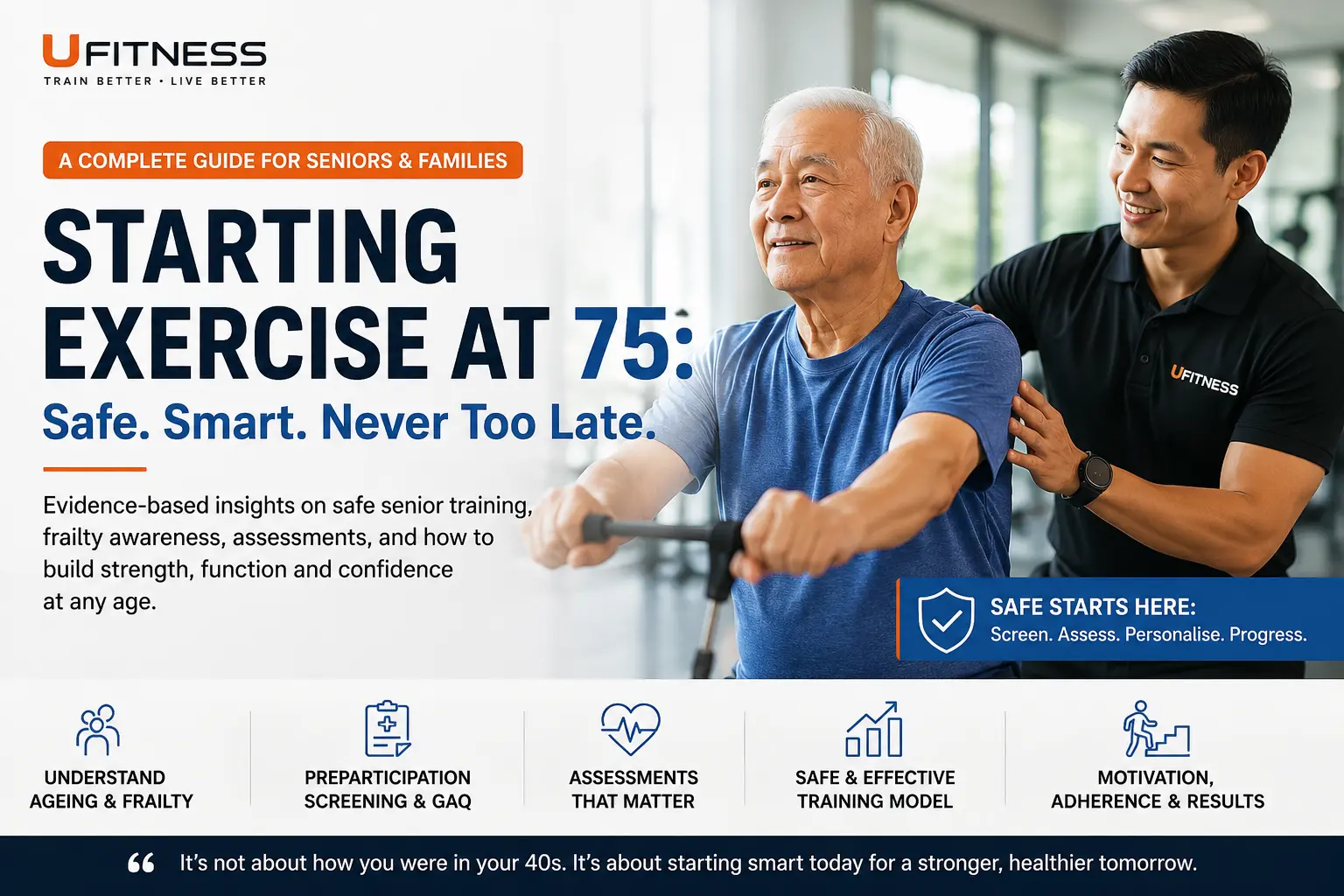
Never Too Late to Start at 75: Safe Exercise When Frailty Starts to Surface
No, it is not too late. But at 75 and beyond, it is no longer wise to start blindly. Safe training for older adults begins with screening, conversation, functional awareness, and where needed, medical clearance before exercise.
Singapore is ageing rapidly, and many families are now asking an important question: “Can I still start training at 75?” The answer is yes — but the approach must change. At this stage of life, exercise is less about chasing youth and more about protecting mobility, independence, strength, balance, confidence, and quality of life.12
Singapore’s older-adult population is not only growing — it is becoming more diverse. Some older adults remain robust and active. Others are slowed down by arthritis, diabetes, osteoporosis, heart disease, poor balance, cognitive decline, frailty, fear of falling, or the effects of a recent illness or hospital stay. That is why older adult exercise cannot be reduced to one slogan, one workout, or one generic “senior class.”
Why this topic matters now
The rise in older-adult enquiries is not surprising. Singapore’s ageing trend means more families will be looking for guidance on how to stay active safely, not only for lifespan, but for healthspan — the ability to move, cope, function, and live with dignity for as long as possible.2
What many older adults hope for
- To get up from a chair more confidently
- To walk further without excessive fatigue
- To climb stairs with less fear
- To reduce falls risk
- To stay independent at home
- To remain socially active and mentally engaged
What families are often worried about
- “Is it too late to start?”
- “Will exercise be too risky?”
- “Can Mum or Dad still train after illness or weakness?”
- “What if they still think they can train like they used to?”
- “Should we get medical clearance first?”
These are valid concerns. Exercise remains one of the most powerful tools for older adults — but it should be matched to the individual’s current condition, not their memories of what they could do 20 or 30 years ago.
All seniors are different
Two people can both be 75 and yet be completely different in function, reserve, motivation, medical history, and risk. Chronological age alone does not tell us enough. A safe and meaningful programme must consider the whole person.
The physiology of ageing: what changes as we grow older?
Ageing is associated with changes in muscle mass, strength, balance, bone health, mobility, and recovery capacity. These changes do not mean exercise should stop — in fact, they are the reason exercise becomes more important. But they do mean the programme must be adjusted thoughtfully.8910
Common age-related changes
- Loss of muscle mass and strength
- Reduced power and slower reaction time
- Lower bone density and higher fracture risk
- Reduced balance and gait efficiency
- Joint stiffness and movement limitations
- Reduced cardiovascular reserve
- Slower recovery after exertion or illness
What this means in practice
- Intensity may need to start lower
- Progression should be slower and more individualised
- Technique, posture, and pacing matter more
- Functional training becomes highly relevant
- Balance and fall-prevention work should not be ignored
- Fatigue, breathlessness, dizziness, and pain must be respected
Older adults can still benefit from exercise. Singapore’s and WHO’s guidance both support regular aerobic, strengthening, and balance-focused activity for adults aged 65 and above, with modification based on ability and mobility.89
Frailty: when “slowing down” starts to matter
Frailty is not simply old age. It reflects reduced physiological reserve and increased vulnerability to stressors, such as illness, falls, or even a seemingly minor setback. The Clinical Frailty Scale is commonly used to summarise the overall level of fitness or frailty of an older adult after evaluation by an experienced clinician.6
Examples along the frailty-awareness spectrum
| Frailty awareness cue | What it may look like | Training implication |
|---|---|---|
| Fit / Well / Managing Well | Still mobile and independent, but may not be training regularly | Build a structured programme with attention to strength, aerobic fitness, balance, and mobility |
| Vulnerable | Slowed up, tired, reduced reserve, less tolerance for stress | Start conservatively; monitor fatigue, recovery, and function closely |
| Mild to Moderate Frailty | Needs help with higher-order tasks, mobility is declining, walking or stairs are more difficult | Functional training, safety support, family communication, and possible medical review become more important |
| Severe Frailty | Dependent in personal care or highly limited function | Requires a more clinical, multidisciplinary, or rehabilitation-oriented approach |
The published CFS framework ranges from “Very Fit” through increasing frailty, including “Vulnerable”, “Mildly Frail”, “Moderately Frail” and more severe levels.67
Why screening must come before training
This is one of the most important points for coaches, trainers, and families to understand: an older adult should not be placed into exercise just because they are motivated. Motivation is valuable — but it does not replace screening, clinical awareness, or professional judgment.
ACSM’s updated approach to preparticipation screening considers the person’s current physical activity level, known cardiovascular, metabolic or renal disease, signs or symptoms, and the intended exercise intensity.3
The role of the Get Active Questionnaire
The Get Active Questionnaire (GAQ) is a useful self-report screening tool intended to help people become more physically active safely. It asks about key issues such as heart disease or stroke, high blood pressure, dizziness, shortness of breath at rest, bone or joint problems, and other relevant health concerns. If the answer is “yes” to any question, further advice or review may be needed.5
GAQ helps identify
- Recent cardiac or stroke-related history
- High blood pressure concerns
- Dizziness or lightheadedness
- Shortness of breath at rest
- Bone or joint issues that may worsen with activity
- Other health concerns needing clarification
GAQ does not replace
- A proper intake interview
- Professional judgment
- Functional observation
- Medication review discussion
- Medical clearance where needed
- Ongoing monitoring during exercise
How the ACE Integrated Fitness Training® Model supports safer older-adult coaching
The ACE Integrated Fitness Training® Model is useful for older-adult coaching because it does not treat every client the same. It provides a client-centred framework that starts from the individual’s current condition, readiness, and goals, then guides progression in a safer and more structured way.12
For a 75-year-old beginner, this means the coach should not simply copy a gym programme designed for a younger adult. The starting point should be based on current function, confidence, health background, balance, mobility, movement quality, recovery ability, and daily living needs.
1. Rapport before prescription
The first session should not be a hard workout. It should begin with trust, conversation, health history, expectations, fears, goals, and readiness to change.
2. Assessment before loading
Before adding resistance, observe posture, balance, mobility, gait, sit-to-stand ability, breathing response, pain behaviour, and confidence.
3. Stability and mobility before intensity
ACE’s IFT materials place importance on posture, balance, movement, range of motion, stability, and mobility before more advanced loading.13
4. Aerobic base before harder cardio
For many older adults, the first cardio goal is to tolerate gentle movement safely, not to chase aggressive intensity. Talk test, perceived effort, symptoms, and recovery matter.
Scope clarification: The ACE IFT Model is a fitness programming framework. It is not a medical diagnosis, frailty diagnosis, physiotherapy assessment, or a replacement for medical clearance when symptoms or health concerns are present.
UFitness safe-start interpretation of ACE IFT for a 75-year-old beginner
In practical coaching terms, the model can be applied as a simple pathway: build trust, screen carefully, restore confidence, improve movement quality, then progress strength and endurance gradually.
Stage 1: Protect and prepare
- Clarify readiness and medical concerns
- Use GAQ, intake discussion, and informed consent
- Request medical clearance where needed
- Begin with low-complexity, low-threat movement
Stage 2: Stability, mobility and confidence
- Gentle mobility and supported balance
- Posture, breathing, and safe transitions
- Supported sit-to-stand practice
- Movement confidence before heavier loading
Stage 3: Movement and daily function
- Step practice and gait confidence
- Reaching, carrying, turning, and standing tasks
- Light resistance for major muscle groups
- Gradual aerobic base through walking or supported cardio
Stage 4: Build reserve and maintain
- Progressive resistance where appropriate
- Longer tolerated aerobic activity
- Balance progression based on safety
- Home routine and long-term adherence
What should be covered in the preparticipation interview?
A screening form is useful. A real conversation is even more important. Many older adults under-report symptoms, overestimate capacity, or minimise risk because they do not want to feel “old.” That is why the intake interview matters.
Key questions to ask
- What is your main reason for wanting to start now?
- What activities are becoming harder at home or outside?
- Any falls, near-falls, dizziness, chest discomfort, or unusual breathlessness?
- Any recent hospitalisation, surgery, infection, or sudden weight loss?
- What medical conditions have been diagnosed?
- What medications are you taking?
- What kind of physical activity are you doing now?
- What would success look like for you in 8 to 12 weeks?
What to observe
- How they walk into the room
- Whether they need arm support to stand
- Balance confidence when turning or changing direction
- Posture, guarding, stiffness, or pain behaviour
- Breathing pattern at rest and with simple movement
- Processing speed, attention, and ability to follow cues
- Fear of movement or overconfidence
Common health challenges older adults may present with
Older adults often live with one or more chronic conditions. HealthHub notes common concerns among older people, including arthritis, heart disease, respiratory disease, osteoporosis, diabetes, falls, depression, and physical limitations affecting vision, hearing, balance, agility, or strength.11
Cardiometabolic
Hypertension, diabetes, high cholesterol, deconditioning, poor endurance, and reduced exercise tolerance.
Musculoskeletal
Osteoarthritis, back pain, osteoporosis or osteopenia, sarcopenia, reduced grip strength, poor sit-to-stand capacity.
Balance & function
Falls history, poor gait speed, reduced confidence, difficulty on stairs, difficulty rising from chairs or walking outdoors.
Neurological / cognitive
Stroke history, mild cognitive impairment, slower processing, coordination challenges, dual-task difficulties.
Medication-related
Polypharmacy, fatigue, orthostatic symptoms, blood sugar fluctuations, altered heart rate or blood pressure response.
Psychosocial
Fear of falling, low confidence, grief, isolation, low adherence, or pressure from family rather than self-driven motivation.
Conducting assessments: what is useful and safe?
Assessments should be chosen based on the client’s status, goals, and safety profile. They should inform the programme, not intimidate the person. The aim is to learn how the older adult moves, tolerates effort, and performs meaningful tasks.
| Assessment area | Examples | Why it matters |
|---|---|---|
| Baseline interview | GAQ, health history, falls history, medication discussion, goals, fatigue and pain history | Guides safety decisions and clarifies readiness |
| Resting measures | Resting heart rate, blood pressure where appropriate and within scope, symptom check | Helps identify whether the session is suitable to proceed |
| Lower-body function | Sit-to-stand observation, 30-second chair stand where suitable, supported squat pattern | Relevant to transfers, stairs, and daily independence |
| Mobility & gait | Comfortable walking observation, gait speed, turn quality | Useful for mobility capacity and fall-risk awareness |
| Balance | Feet-together stance, tandem progression, supported single-leg balance, dynamic balance tasks | Important for fall prevention and confidence |
| Endurance | Short supervised walking tolerance, light step test, low-level cycling or marching as appropriate | Helps pace aerobic programming safely |
| Strength / upper body | Light resistance tolerance, grip strength if available, carry or reach tasks | Supports posture, ADLs, and confidence |
A practical training model for older adults starting late
A good older-adult programme is usually multicomponent rather than one-dimensional. Singapore’s and WHO’s recommendations support a mix of aerobic activity, muscle strengthening, and balance-focused work, adjusted to the person’s functional level.89
Phase 1: Protect and prepare
- Clarify readiness and obtain clearance where needed
- Teach breathing, pacing, posture, and safe transitions
- Build confidence with low-complexity movements
- Reduce fear and establish trust
Phase 2: Restore basic function
- Sit-to-stand patterns
- Supported lower-body strengthening
- Step practice, gait quality, and balance drills
- Light endurance intervals
Phase 3: Build strength and reserve
- Progressive resistance training
- Hip, thigh, back, and core strengthening
- Carrying, reaching, lifting, and task-based function
- Longer bouts of tolerated aerobic work
Phase 4: Maintain and live better
- Consistency over intensity
- Home routines and simple daily activity habits
- Family support and routine reinforcement
- Ongoing reassessment and progression
What a balanced weekly plan may include
- Aerobic activity: walking, supported cycling, marching, or other suitable moderate activity
- Strength: two or more days per week focusing on major muscle groups, where appropriate
- Balance: regular balance work, especially for those with poorer mobility or falls risk
- Mobility / flexibility: supportive work to maintain comfort and movement quality
- Functional tasks: sit-to-stand, stairs practice, carrying, turning, and safe transfers
Motivation and adherence: why older adults stay with a programme
Older adults are more likely to adhere when training feels relevant, safe, respectful, and achievable. Many are not motivated by aesthetics. They are motivated by function, independence, pain reduction, confidence, family roles, and the hope of staying active for as long as possible.
What improves adherence
- Clear functional goals
- Small wins that are visible early
- A calm, respectful, non-judgmental coach
- Predictable routine and pacing
- Family support where appropriate
- Programmes tailored to energy level and confidence
What commonly reduces adherence
- Sessions that are too hard too soon
- Fear of pain or falling
- Medical setbacks
- Transport or schedule barriers
- Low confidence after a difficult experience
- Unrealistic expectations from self or family
When a coach should slow down, pause, or refer out
- New chest pain, chest pressure, or unexplained discomfort with activity
- Unusual breathlessness at rest or with low-level activity
- Dizziness, fainting, or repeated near-falls
- Sudden neurological symptoms or unexplained weakness
- Uncontrolled pain, sudden swelling, or acute illness
- Recent surgery, hospitalisation, or new diagnosis not yet clarified
- Blood pressure concerns, medication issues, or any “not right” presentation
Screening should consider symptoms, medical conditions, current medications, and situations that may require consultation with medical personnel before testing or training.3
So, is it too late to start at 75?
No. It is not too late.
But the goal at 75 is usually not to prove that someone can still train like they were in their 40s. The real goal is often more meaningful:
- to stay upright,
- to keep walking,
- to remain independent,
- to reduce falls risk,
- to maintain confidence, and
- to preserve dignity and quality of life for as long as possible.
Relevant UFitness pages
These pages support the reader journey from awareness to readiness and action.
Important note
This article is for education and general awareness only. It does not provide medical diagnosis, medical treatment, physiotherapy, rehabilitation prescription, or personalised healthcare advice. UFitness coaching should remain within the scope of exercise and fitness practice. Older adults with symptoms, multiple medical conditions, recent illness, falls, surgery, unstable health status, or uncertainty about exercise readiness should seek appropriate medical advice and, where relevant, obtain exercise clearance before training.
References
- Singapore Department of Statistics. Latest News & Data – Elderly, Youth and Sex Profile .
- Population.gov.sg. Longevity .
- Exercise is Medicine / ACSM. ACSM Preparticipation Screening Guidelines .
- American College of Sports Medicine. ACSM Certification and Professional Resources .
- Canadian Society for Exercise Physiology. Get Active Questionnaire .
- Dalhousie University. Clinical Frailty Scale .
- British Geriatrics Society. Clinical Frailty Scale Reference .
- HealthHub Singapore. Singapore Physical Activity Guidelines for Older Adults .
- World Health Organization. Physical Activity .
- National Institute on Aging. Health Benefits of Exercise and Physical Activity .
- HealthHub Singapore. Healthy Living in Your Golden Age .
- American Council on Exercise. ACE Integrated Fitness Training® Model .
- American Council on Exercise. ACE Integrated Fitness Training Model for Exercise Program Design .